


Towards the Digital Fairness Act: Interview with Catalina Goanta on Influencer Marketing
The forthcoming Digital Fairness Act is anticipated to be introduced as a legislative initiative in the fourth quarter of 2026. For this second post of this blog series on the DFA, we have interviewed Dr. Catalina Goanta (UU) about influencer marketing to learn about her view on how to regulate it.
Introduction
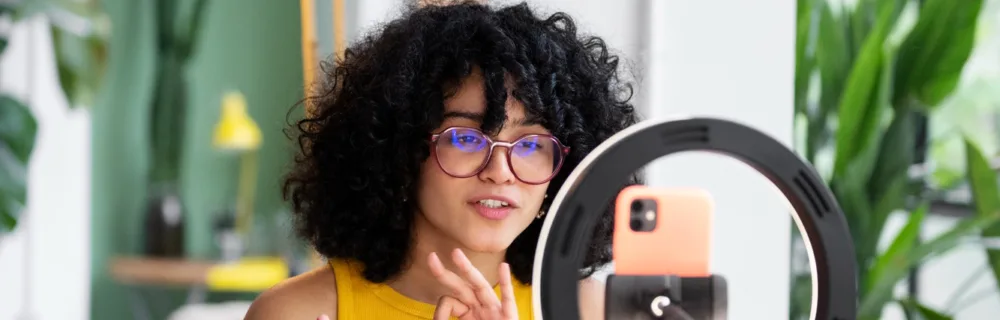
Influencer marketing plays an important role in the digital economy, with companies increasingly investing in this form of promotion. The Influencer Marketing Benchmark Report 2026 reflects this clearly: among the 600+ marketing professionals surveyed, 87.49% expect their influencer marketing budget to increase in 2026, with 72.22% planning an increase of 50% or more. This growth comes with significant problems. Influencer endorsements may exploit consumer vulnerabilities, for example by promoting dubious health supplements or high-risk financial products. Moreover, transparency often remains insufficient, with many influencers failing to clearly disclose the commercial nature of their content.
At the EU level, the legal framework applicable to influencer marketing is spread across several regulatory regimes. Currently, one of the key EU instruments regulating influencer marketing is the Unfair Commercial Practices Directive (UCPD), which tackles hidden advertising and misleading commercial practices. In addition, the Digital Services Act (DSA) regulates influencer marketing indirectly through platform obligations. It imposes obligations on online platforms related to advertising transparency (Article 26). Furthermore, it restricts targeted advertising to minors (Article 28) and requires platforms to collect certain identification information from influencer-traders (Article 30).
Although hidden advertising and misleading commercial practices are thus prohibited, the responsibilities of the different actors in the influencer marketing ecosystem remain unclear. This is one of the reasons why further regulation of influencer marketing is deemed necessary by the European Commission. The public consultation of the DFA explored several potential policy interventions for regulating influencer marketing, asking respondents whether they support the following measures:
- Influencers should disclose advertising clearly and prominently;
- Brands and agencies should take measures to ensure that influencers comply with legal obligations;
- Specific types of claims by influencers should be restricted to protect minors, e.g. claims about unhealthy foods, dietary supplements, plastic surgery, cosmetic procedures, tobacco/vaping, or promotion of unrealistic beauty standards.
The inclusion of these specific policy options in the consultation indicates the regulatory directions the European Commission is considering for addressing non-disclosure and other harmful practices in influencer marketing, building upon the existing regulatory framework. However, the question is whether this is the right way forward, and if so, whether it would be enough.
To gain a better understanding of the challenges surrounding influencer marketing, and how the policy options currently under consideration should be evaluated, we have interviewed Catalina Goanta, one of the leading experts in this field. She is an associate professor in private law and technology at Utrecht University and the principal investigator of the ERC Starting Grant project HUMANads, which focuses on understanding the impact of content monetization on social media and on reinterpreting private law fairness in the context of platform governance. A central area of her research concerns content and web monetization and social media governance, including issues such as influencer marketing, which is the focus of this interview.
Interview:
What do you currently consider the most harmful influencer marketing practices for consumers?
Catalina Goanta: Before talking about harms, first, we need to acknowledge that influencer marketing has turned into a broader industry of the content creation economy. Creators can be advertisers, one of the main concerns under the current regulatory reform, but they can also be sellers or providers of products or services. Unfortunately, the Digital Fairness Act Fitness Check has not taken this on board. Here, I will still refer to influencer marketing, but keep in mind that the industry has become much broader than just that. Second, we need to consider that there are also a lot of benefits to influencer marketing. For example, the European Commission itself uses influencers to promote consumer rights. The regulatory discussion should therefore not start from only the idea that influencers are bad.
However, focusing on the harms of influencer marketing, the most obvious harm is the failure to disclose the fact that the content is an advertisement. Our research team at Utrecht University has done extensive empirical research that aligns with studies from the UK, US, and Slovakia, showing that most advertising content posted by influencers remains undisclosed. For one specific business model, affiliate marketing, where we can clearly establish that a post is advertising because it promotes an affiliate code, we found that only up to 5% of that content is actually disclosed. And we looked at influencers registered with the Commissariaat voor de Media, who are supposed to be the most professional content creators in the Netherlands.
And then there are many other types of harms related to influencer marketing, which are much wider-reaching. For example, addictive design discussions focus on interfaces, but people scroll through content driven by "parasociality”. It is a unilateral relationship between a viewer and a content creator, where there’s a lot of admiration, there’s a lot of positive feelings that the user is going to see and feel when looking at the content of a content creator that they admire. If we treat issues like influencer marketing and addictive design as separate, we are missing the main view that these are very intertwined issues.
The Digital Fairness Fitness Check suggests that, although EU consumer law already prohibits hidden advertising and misleading practices, important gaps remain in the influencer marketing ecosystem. In particular, it highlights legal uncertainty regarding the allocation of responsibilities between influencers, brands, agencies, and platforms, and specific concerns that go beyond transparency. Do you agree with this assessment? In your view, what are currently the most significant shortcomings in the legal protection of consumers against influencer marketing?
Catalina Goanta: We already have quite a lot of rules that can cover influencer marketing, and the Unfair Commercial Practices Directive is one of them. Although it dates from 2005, its principle-based, future-proof design means that its generic tests can apply to any novel industry. For example, as Joasia Luzak and I have argued, point 11 of Annex I on advertorials can very easily apply to influencer marketing. This is also reflected in the Commission's guidelines on the UCPD.
Through our work in the e-Enforcement Academy, we noticed that one of the biggest issues is the complexity of business models. Platforms are sitting on key information, and keeping track of rapidly evolving content monetisation models is very difficult for authorities with limited resources. Basically, what is happening is that we have a very generic test, very little knowledge about how the industry works, and then a lot of pragmatism in applying one to the other.
In addition, enforcement is also an issue because of the definition of a trader. The definition of a trader is super open. There are no fixed benchmarks as to 'you make X amount of money, then you become a trader' or 'you're a trader when you're registered as a company or freelancer.' What happens if you have 1,500 followers on Instagram and have made three brand posts in one year? Is that enough to qualify as a trader?
And there is a visibility problem: there's no way authorities can get an idea of what is happening on these markets without doing scaled computational monitoring. National registries could help, but the core shortcoming is a power imbalance between the industry and authorities who need to apply the law.
The European Commission’s public consultation on Digital Fairness Act explored several policy options, such as requiring clear advertising disclosure by influencers, obliging brands and agencies to ensure influencer compliance. Do you think these measures would be sufficient to address the problem you just described, or are there important aspects that they missed in these options?
Catalina Goanta: I definitely think that there are important aspects that were missed, and these aspects deal with the fact that business models are constantly changing. For instance, many creators are moving to live streams, where advertising is much harder to detect; you either catch it or you don't, and platforms lack the tools to deal with advertising in live streaming environments. This is a clear gap.
Regarding disclosure, the key issue is that the UCPD is a maximum harmonisation directive, so no national authority can prescribe specific hashtags. Yet practices vary by country. That is why any DFA policy option should focus on standardising disclosures through platform affordances, meaning built-in tools and features that platforms provide for creators to label their content as advertising, mandating platforms to have more control over non-disclosed content.
This ties in with the role of intermediaries. Consumer law is also a law for intermediaries, and the Digital Services Act already has obligations dealing with interface design. But the Digital Services Act specifically did not address influencer marketing in its Article 26 on advertising, because its definition of advertising requires that you pay the platform for the ad for it to be qualified as such. This means that when a brand pays an influencer directly to promote a product, but does not pay the platform to display that post, it falls outside the DSA's advertising rules. So the DSA specifically excludes influencer marketing from its advertising provisions. However, Article 26(2) does oblige platforms to provide a functionality for creators to declare whether their content is or contains advertising. Now the Digital Fairness Act should somehow piggyback on that provision and reinstate it through consumer protection legislation, making sure this is standardised, because this is the only way in which creators are going to be educated to use it, and this way it's clear for everyone that a post is an ad.
We know that some member states have adopted different approaches (binding laws and soft law measures) for influencer marketing, such as France, the Netherlands, and Spain. How do you assess the effectiveness of these measures? Do you think these national measures can serve as a benchmark for the incoming Digital Fairness Act?
Catalina Goanta: It is important to note that the laws referenced for the Netherlands and Spain are media laws advertising regulations adopted under the Audiovisual Media Services Directive. France's influencer law is a consumer protection instrument, but many of its provisions rely on the discretion that France has to make laws for public health. This is to avoid conflict with the UCPD's maximum harmonisation spirit, which raises an interesting debate. If the DFA is supposed to include public health grounds as well, or to add public health-related practices in a list, does that conflict with the current role of member states to legislate nationally on these matters? That is a political question. France's enforcement is very much based on fear, and certain practices can lead to jail time. The fine amounts are nothing for mega-influencers, but going to jail is bad. However, the DFA is not going to be able to unify and harmonise sanctions to that extent, because some member states like the Netherlands do not impose criminal sanctions for the breach of such laws, while France and Denmark do. What works nationally might not work in a harmonised way.
Instead of harmonising sanctions, we can take inspiration from media law registries. But this is not how the creator economy works. Follower thresholds are problematic because gaining followers on TikTok is exponentially faster than on YouTube. In the Netherlands, the threshold was lowered to 100,000, creating the unfortunate impression that smaller influencers need not disclose. There should be harmonised measures to identify influencer profiles, perhaps through revenue, but note that thresholds cannot be uniform across the EU.
Is there anything else you would like to add?
Catalina Goanta: We shouldn't look at the Digital Fairness Act as a solution to all consumer problems. But we also shouldn't forget that we have 50 years of European consumer legislation. A lot of it still works, and it can still be applied very smoothly to novel issues. We shouldn't over-complicate this legislation but actually try to figure out how to clarify its scope and its applicability.